Why the title says MBSE for AI, and why I nearly flipped it
Months after naming my book, I could not remember why it read "MBSE for AI" and not the other way round. Working it out again gave me a simple test for naming any AI initiative: put the thing you are changing first.
A few weeks ago I looked at the cover of my own book and could not remember why it said MBSE for AI. The phrase everyone uses is the other one, AI for MBSE. It reads more naturally. It sounds like what a buyer wants. For about an hour I was ready to flip it.
Then I worked through what each title promises, and kept it. The reason turned out to be a test I now use for naming any AI initiative.
The test: what changes, and what stays the same?
In a phrase of the form X for Y, X is the thing you build or change. Y is who it serves. So the two titles describe two different projects.
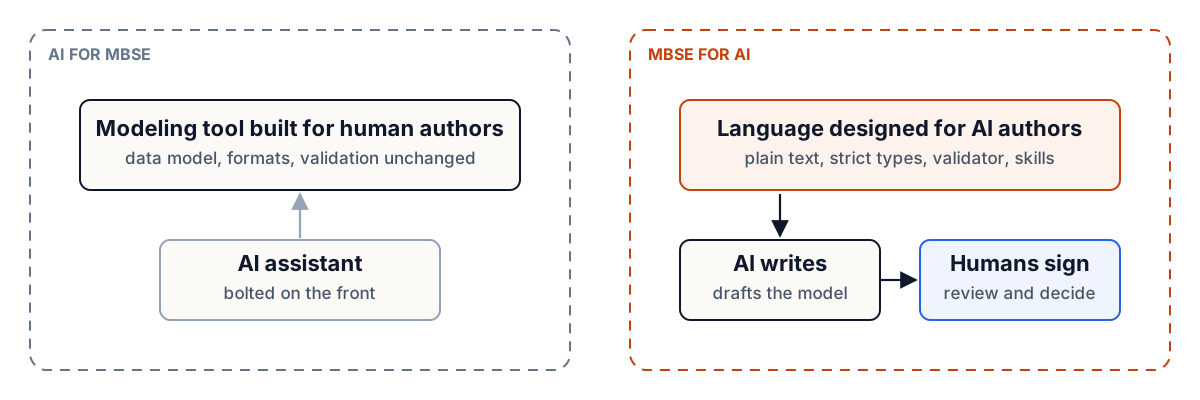
Figure 1. On the left, the modeling tool stays as it was and an assistant is added in front. On the right, the language itself changes so AI can author the model and people review and sign.
| Question | AI for MBSE | MBSE for AI |
|---|---|---|
| What gets built? | An assistant | A modeling language |
| What stays the same? | The tool, its data model, its formats | Accountability: people still sign |
| Who is the primary author? | A person, with help | AI, with review |
| Where does checking happen? | In the person’s head | In a deterministic validator |
| What the auditor sees | The same artefacts, produced faster | Artefacts with a machine-checked trail |
AI for MBSE is a fine product. It is just not what the book is about. The book argues that the modeling language has to change: plain text that a model can read and write, strict types, a validator that gives the same answer every time, and a skill file for every file type that tells the AI author the rules. Those are changes to MBSE. AI is who they serve.
Why the subtitle matters as much
A title that puts AI in the author’s seat raises the obvious worry: who is responsible? So the subtitle answers it in eight words: Engineering models that AI writes and humans sign. Writing and signing are different jobs. The book is about making the first one cheap without making the second one blind.
Where the reason was hiding
My answer to “why this title” was in the book all along, in a section of the first chapter. Readers who opened the reader at the front page never saw it. If I could lose track of the reason, a reader had little chance of finding it.
So I put it up front. The book’s front page in the reader now opens with a short page called Why the title says MBSE for AI, before the contents. It is the first thing you turn to after the cover.
Using the test on your own initiatives
I have started applying the same question to AI programmes I review. Read the name and ask which word is being changed.
| Name | What it implies you will change |
|---|---|
| AI for requirements | Nothing about your requirements. You add a tool. |
| Requirements for AI | How requirements are written, typed and checked, so a model can work with them safely |
| AI for testing | Nothing about how tests are specified |
| Testing for AI | How you test systems that contain models |
Neither form is wrong. They are different budgets, different owners and different timelines. Adding a tool is a quarter. Changing the thing itself is a programme. Naming it honestly up front saves the argument six months later, when someone asks why the assistant did not fix the process.
The book is free to read at bbalaji.com/book. The front page now says why it is called what it is called, so I will not have to work it out a third time.