AI’s only real novelty is speed
For most enterprises, AI does not do anything new. It does what we already knew how to do, at a cost and pace that change which work is worth doing. That is where strategy should start.
Strip away the demos and ask a plain question: what can an enterprise do with AI that it could not do before?
For most companies that are not in the AI business, the honest answer is uncomfortable. Almost nothing. What it can do is the same things it already knew how to do, much faster and much more cheaply. That sounds like a deflating answer. I think it is the most useful starting point an AI strategy can have.
The ideas were already here
Look at the work AI is being sold for and trace it back.
Ontologies and knowledge graphs, the idea that you can model what a business knows as entities and relationships, have been around for decades. Turning unstructured documents into structured data was the job of information-extraction pipelines, OCR and armies of analysts long before large language models. Risk assessment is older still: failure mode and effects analysis came out of military engineering in the 1940s, and safety-critical industries have run it on every product since.
In automotive safety we have spent twenty years building traceability from requirements to architecture to tests. None of that needed AI. It needed people, time and discipline, and it was expensive enough that we rationed it.
That is the point. The concepts were never the constraint. The constraint was the cost of applying them.
What changed is the cost curve
When an analysis that took a team three weeks can be drafted in an afternoon, nothing conceptually new has happened. But the economics of the work have changed, and economics decide what gets done.
Work that is cheap gets done more often, on more things and at a finer grain. A design review that happened once per programme can happen on every change. A supplier contract that was skimmed can be read in full. A requirements set that was checked by sampling can be checked line by line. Licence usage that was reconciled once a year can be watched continuously.
None of these are new activities. They are activities we always valued and could not afford to do as much as we wanted. AI moves them from rationed to routine.
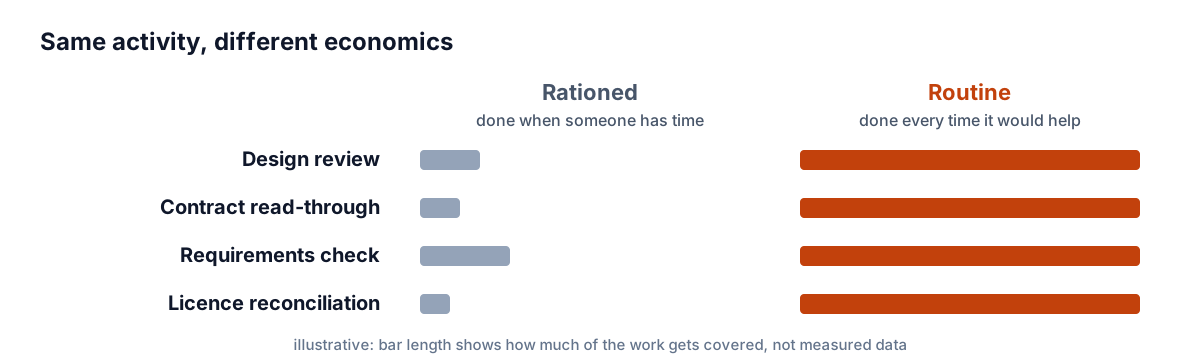
Figure 1. Illustrative, not measured. The same four activities, before and after the cost of a first draft falls. Nothing new is being done. Far more of it is.
| Activity (typical pattern) | When it is expensive | When it is cheap |
|---|---|---|
| Design review | Once per programme milestone | On every significant change |
| Supplier contract | Skimmed for the commercial terms | Read in full against a checklist |
| Requirements set | Checked by sampling | Checked line by line for ambiguity and gaps |
| Licence usage | Reconciled once a year | Watched continuously |
That last row is not hypothetical for me. Applying AI to engineering licence usage and optimisation produced measurable savings in its first year. Matching licences to real usage is a decades-old idea. What changed was the cost of doing the analysis properly.
What this means for strategy
If the novelty is speed, a few things follow.
Start from the work you ration, not from the technology. The best first use cases are rarely the most exciting. They are the reviews, analyses, cross-checks and documents that everyone agrees are valuable and nobody has time to do properly. Ask each function: what would you do every day if it took minutes instead of weeks?
Measure time, coverage and decision quality, not novelty. The value shows up as shorter cycle times, more of the portfolio covered, fewer things discovered late. If a use case cannot name the clock it is shortening, it is probably a demo.
Fund faster processes, not AI projects. An “AI project” has a sponsor who likes AI. A faster process has an owner who lives with the result. The second survives contact with production; the first usually does not.
Expect the bottleneck to move. When drafting gets ten times faster, review becomes the constraint. The organisations that win are the ones that redesign review, with better evidence, clearer acceptance criteria and evaluation built into the pipeline, instead of asking the same experts to read ten times as much.
Speed amplifies whatever you already are
There is a darker side to the same observation. Speed does not only multiply good decisions. A weak process run ten times faster produces ten times as many weak outcomes, with more confidence and less friction.
This is where twenty years in safety-critical engineering shape how I think about AI. In a braking system, you do not get to say the model was usually right. You produce evidence as you build: what the requirement was, how the design meets it, what test proves it, who signed it off. That evidence is not bureaucracy. It is what lets you move fast without betting the company on every change.
Enterprise AI needs the same habit. Traceability from the business question to the model, the prompt, the data and the decision. Evaluation that runs every time something changes, not once at launch. Clear accountability for who accepts an output. Done well, this does not slow teams down. It is what makes it safe to let them go faster.
The question worth asking
Most AI strategy sessions open with some version of “What can AI do for us?” It invites a tour of capabilities and a list of pilots.
I prefer a different question: which work would we do far more of, and far better, if it cost a tenth of what it costs today? The answers are usually already sitting in every function’s backlog, waiting for the economics to change.
They just did.